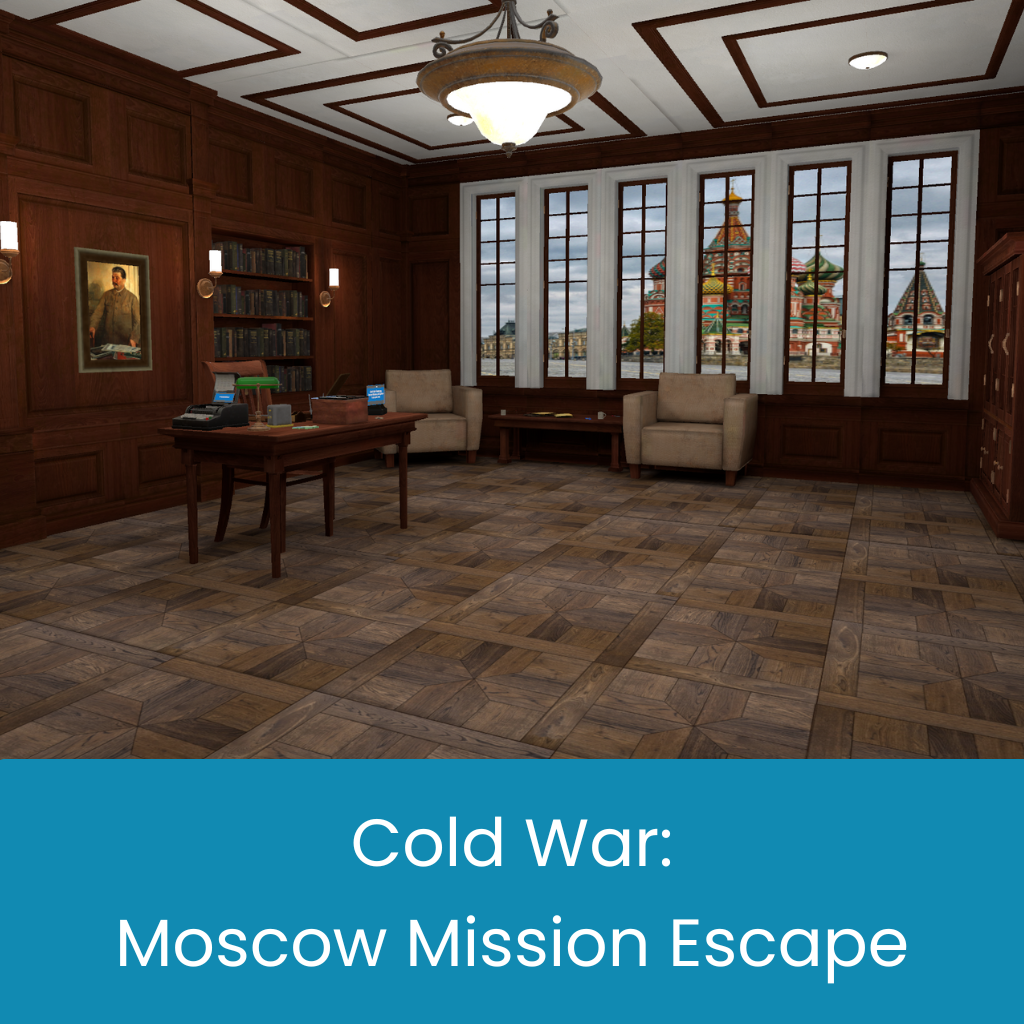
Cold War: Moscow Mission
A spy-themed experience set in a Moscow government office, overlooking the city. Players act as undercover agents tasked with decrypting Cold War events — Truman Doctrine, Berlin Blockade, Korean War, Cuban Missile Crisis, Space Race — to uncover the name of a double agent.
- ROLE
- Lead Unity Developer & Designer
- PLATFORMS
- VR Headsets (primary) / Browser/WebGL (secondary for broader access)
My contributions
- 01
Spy-Themed Gameplay: Coded puzzle logic around historical events like the Berlin Airlift, Marshall Plan, and SALT I treaty.
- 02
VR-First Interaction: Incorporated visual cues, layered 3D documents, and an in-game codex for decryption in VR.
- 03
Cross-Platform Adaptation: Streamlined 3D assets and gameplay flow for WebGL performance.
- 04
Historical Integration: Curated references to major Cold War incidents to ensure educational accuracy.
Overview
A spy-themed experience set in a Moscow government office, overlooking the city. Players act as undercover agents tasked with decrypting Cold War events — Truman Doctrine, Berlin Blockade, Korean War, Cuban Missile Crisis, Space Race, etc. — to uncover the name of a double agent. A WebGL version retains puzzle mechanics and historical data for browser access.
Purpose
Immerse students in Cold War history by letting them solve riddles about key confrontations and policies, showcasing the era's espionage tension and geopolitical complexity.
Core features
- 01
Decryption & Document Analysis: Use a code/cipher to uncover hidden messages referencing Cold War flashpoints.
- 02
Interactive Timeline: Place events like the Berlin Blockade or Cuban Missile Crisis in correct chronological or geographic order.
- 03
Secret Agent Narrative: Dramatic dialogue and environment design to evoke espionage tension.
- 04
Double Agent Reveal: Completing all puzzles yields a dossier on the traitorous agents.
Challenges
- 01
Dense Historical Content: Summarizing multiple Cold War incidents without overwhelming users.
- 02
Multiple Puzzle Types: Cipher decoding, timeline ordering, environment exploration.
- 03
VR vs. WebGL UIs: Ensuring puzzle interfaces work with VR controllers and standard keyboard/mouse.
- 04
Thematic Consistency: Keeping a tense spy atmosphere while conveying educational content.
Solutions
- 01
Story-Driven Puzzles: Each historical event puzzle served the overall spy plot, tying factual data to gameplay.
- 02
Adaptive UI Layout: Different interface setups for VR (floating panels) vs. Web (on-screen windows).
- 03
Selective Focus: Chose the most pivotal Cold War incidents to avoid content overload.
- 04
Multimedia Assets: Combined texts, audio transcripts, and minimal cutscenes for depth without excessive complexity.
Accessibility
- 01
Clear Visual Hierarchy: High-contrast notes, UI elements, and background details to help with visual clarity.
- 02
Voice Guided: Key instructions and textual clues are voiced to support different learning styles.