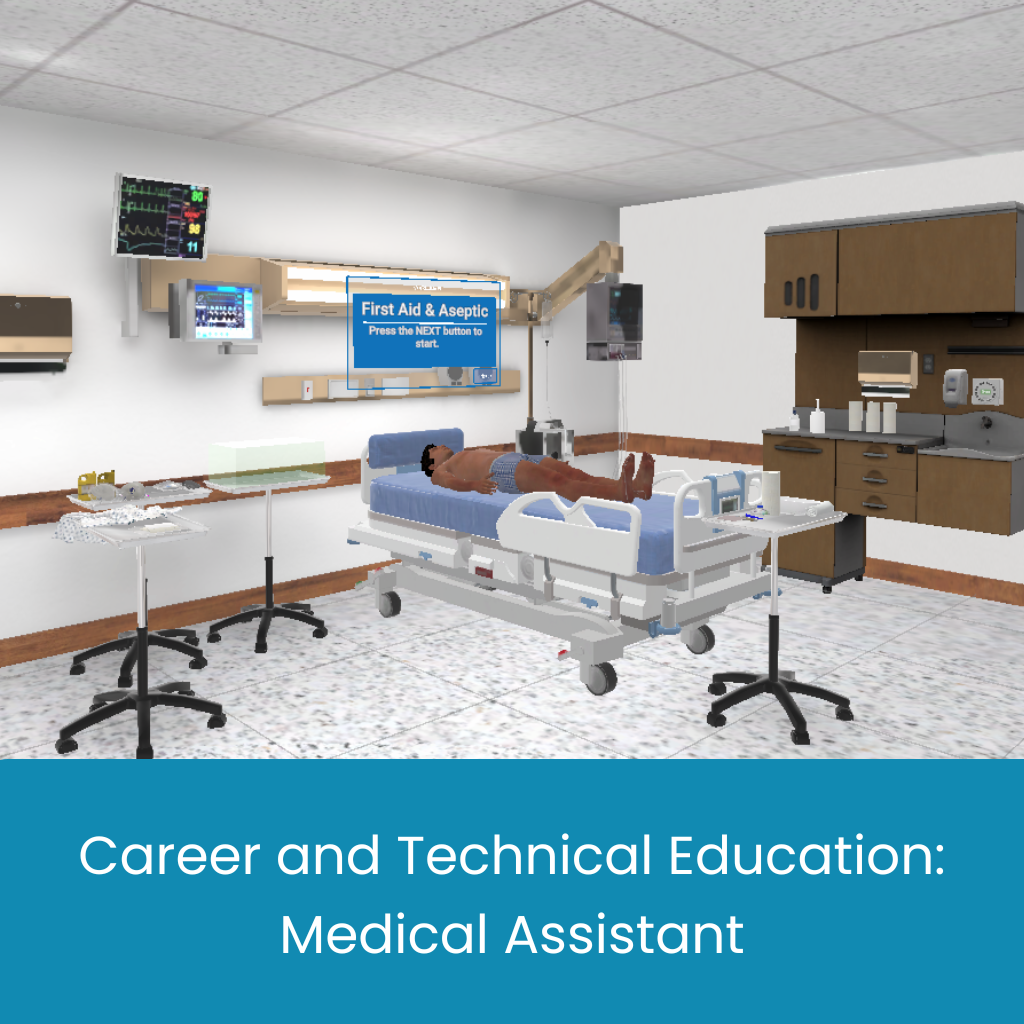
CTE: Medical Assistant
A VR-based medical training experience teaching students the core responsibilities of a Medical Assistant — covering ECG, vision tests, CPR, PPE usage, first aid, biomedical equipment handling, and more. Students develop hands-on skills in a controlled, immersive learning environment.
- ROLE
- Lead Unity Developer
- PLATFORMS
- VR Headsets (primary development) / Browser-Based Training (secondary version)
My contributions
- 01
Medical Simulation Development: Built realistic VR interactions for ECG, CPR, first aid, suturing, and biomedical equipment use, ensuring accurate procedural execution.
- 02
Immersive Environment Design: Modeled and implemented virtual medical training rooms, complete with patient models, hospital tools, and medical equipment.
- 03
Interactive Learning Modules: Developed step-by-step medical scenarios guiding students through each procedure with real-time feedback.
- 04
User Input & Haptics: Designed VR hand-tracking and haptic feedback for tool handling (e.g., AED paddles, ECG leads, scalpels, syringes).
- 05
Performance Optimization: Optimized 3D assets, lighting, and physics-based interactions to ensure smooth VR performance.
Overview
A VR-based medical training experience designed to teach students the core responsibilities of a Medical Assistant, covering essential clinical procedures such as heart rhythm monitoring (ECG), vision tests, CPR, PPE usage, first aid, biomedical equipment handling, and more. Through realistic VR simulations, students develop hands-on skills in a controlled, immersive learning environment, reinforcing knowledge required for medical certification.
Purpose
This experience is part of a Career and Technical Education (CTE) initiative, preparing students for Medical Assistant certification exams by providing realistic simulations of daily tasks in the healthcare field. It enhances learning through interactive, scenario-based training, allowing students to practice medical procedures in a virtual setting before working with real patients.
Core features
- 01
Heart Rhythm & ECG Simulation: Students perform electrode placement, machine calibration, and heart rhythm analysis using a VR ECG device.
- 02
Vision Testing Procedure: Includes both letter-based and symbol-based eye charts, requiring students to document vision test results.
- 03
CPR & AED Training: A real-time CPR simulation with guided chest compressions, rescue breathing, and AED application.
- 04
Personal Protective Equipment (PPE) Simulation: Students learn proper donning and doffing of PPE gear in a healthcare setting.
- 05
Biomedical Equipment Interaction: Hands-on practice with stethoscopes, blood pressure cuffs, centrifuges, microscopes, and more.
- 06
Suture Removal & Wound Dressing: A realistic surgical aftercare scenario where students practice suture and staple removal.
- 07
First Aid & Bleeding Control: Covers wound care, pressure point application, and infection control procedures.
Challenges
- 01
Medical Accuracy: Ensuring that procedures (ECG, CPR, suturing) followed industry standards for real-world medical training.
- 02
VR Interaction Precision: Creating stable hand-tracking mechanics for manipulating small medical instruments in 3D space.
- 03
Performance Optimization: Balancing detailed hospital environments with smooth VR performance and high frame rates.
- 04
Cross-Platform Consistency: Coordinating VR functionality while aligning with the browser-based Medical Assistant version.
Solutions
- 01
Expert Consultation: Worked with medical professionals and educators to verify procedural accuracy and usability.
- 02
Snap-to-Placement Mechanics: Implemented precise snapping for VR hand interactions (e.g., ECG lead placement, AED pads, sutures).
- 03
Efficient Asset Management: Reduced polygon count and texture resolution where possible to improve VR performance.
- 04
Guided Learning Approach: Designed adaptive feedback prompts to correct student errors and reinforce learning objectives.
Accessibility
- 01
VR Controller & Hand-Tracking Support: Ensured ease of use for different play styles (seated, standing, and full-room VR).
- 02
Voice-Guided Instructions: Step-by-step narration to assist students in executing procedures correctly.
- 03
Clear UI & High-Contrast Elements: Designed accessible VR menus and medical charts to improve readability.
- 04
Subtitled Audio & Text Scaling Options: Supported closed captions for medical terminology and scalable text.