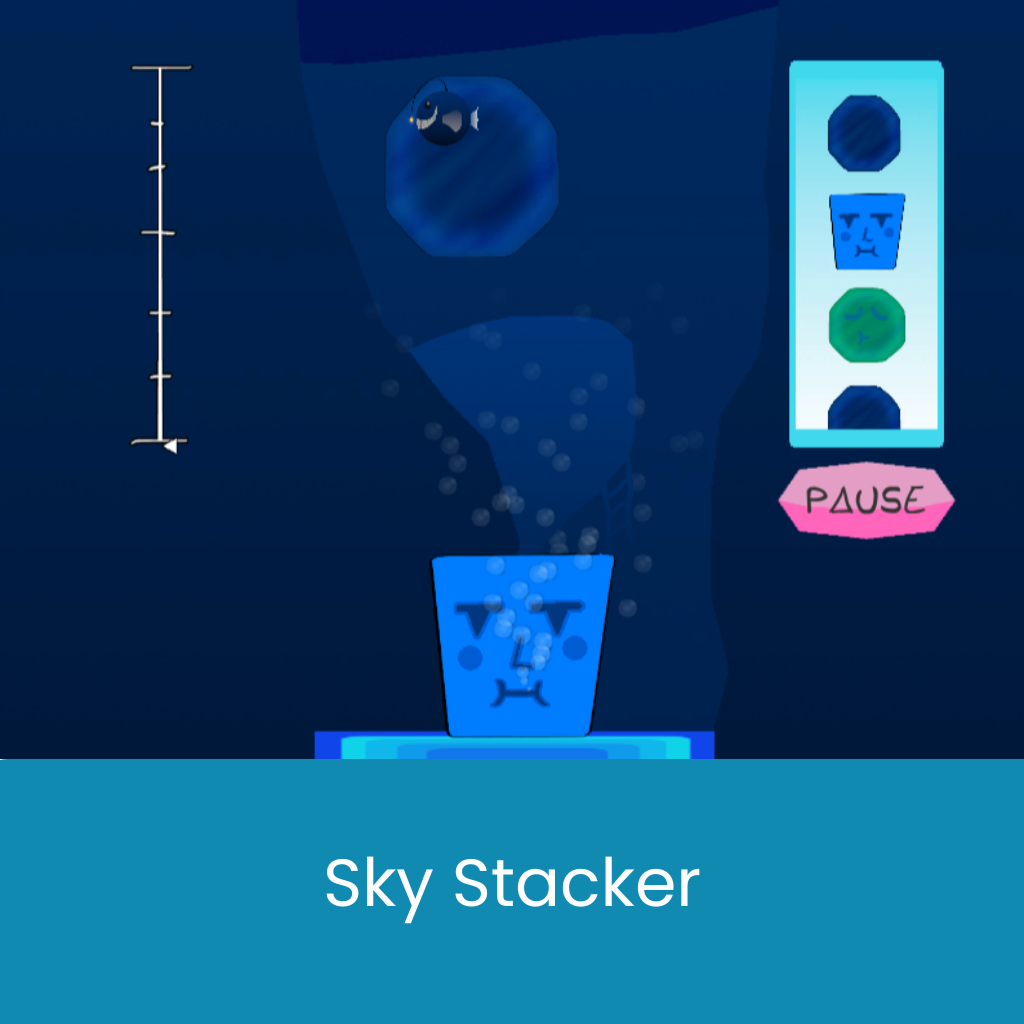
Sky Stacker
A physics-based, 2D block-stacking puzzle game developed by a small indie team during the early days of the pandemic. Sky Stacker challenges players to balance and stack falling blocks while overcoming physics-based obstacles across different environments.
- ROLE
- Lead Programmer
- PLATFORMS
- WebGL (Playable on itch.io)
My contributions
- 01
Physics-Based Stacking System: Developed the core stacking mechanic, ensuring blocks collided, tumbled, and reacted naturally.
- 02
Game Logic & Object Spawning: Implemented a randomized block spawning system with varied physics behaviors and challenges.
- 03
Level Progression & Events: Designed level-specific hazards, such as the shark event in the ocean level.
- 04
Bug Fixes & Optimization: Addressed collision detection, physics inconsistencies, and UI navigation bugs before release.
- 05
Team Coordination: Managed technical planning and feature implementation alongside the lead developer and sound designer.
Overview
A physics-based, 2D block-stacking puzzle game developed by a small indie team during the early days of the pandemic. Sky Stacker challenges players to balance and stack falling blocks while overcoming physics-based obstacles. Players navigate through different environments, avoiding hazards like ocean waves, sharks, and unstable platforms, while aiming to build the tallest, most stable tower.
Purpose
Designed as a collaborative learning experience, Sky Stacker was the team's first completed game together. The project served as a testbed for group development, focusing on team coordination, scoped development, and feature iteration within a short timeframe.
Core features
- 01
Physics-Based Stacking: Players must carefully position and balance falling blocks, avoiding collapses.
- 02
Dynamic Environments: Levels include shifting platforms, rising water, and moving hazards that affect gameplay.
- 03
Power-Ups: Introduced a stability-enhancing power-up to help players reinforce their towers.
- 04
Event-Based Challenges: Special game events, such as a shark knocking into the tower, add unpredictable obstacles.
- 05
Minimalist UI & Feedback: Players receive real-time feedback through animations, sound cues, and particle effects.
Challenges
- 01
Team Coordination & Momentum: Mid-development slowdown due to real-life commitments and motivation dips.
- 02
Physics Complexity: Balancing realistic gravity and physics while keeping the game fun and forgiving.
- 03
Content Scope & Feature Creep: Originally planned for more levels and power-ups, but development time was limited.
- 04
WebGL Performance Optimization: Ensuring stable physics calculations in a browser-based environment.
Solutions
- 01
Extended Development Timeline: Adjusted deadlines to accommodate team availability and keep morale high.
- 02
Iterative Testing & Refinement: Refined physics interactions to prevent frustrating collapses while maintaining challenge.
- 03
Feature Prioritization: Cut underdeveloped power-ups and focused on polishing the core gameplay loop.
- 04
Final QA & Fixes: Addressed major gameplay-breaking bugs, including issues with WebGL credit links.
Accessibility
- 01
Simple Controls: Single-button interaction allows easy pick-up-and-play mechanics.
- 02
Color-Coded Blocks: Ensured blocks were distinguishable for colorblind accessibility.
- 03
Adjustable UI Scaling: Included options for text and interface scaling.